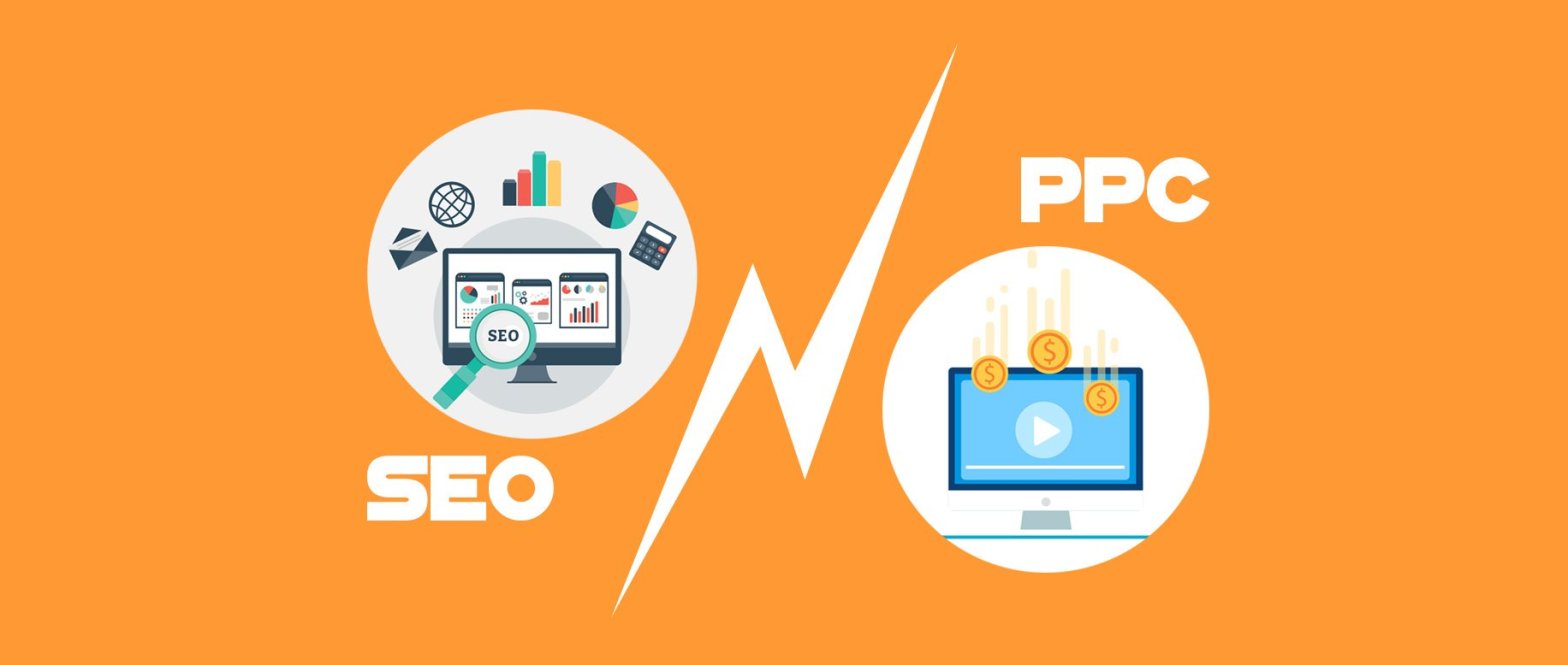
If you have a new website, you most likely want to promote it. You need customers for your business to work.
At the beginning of the road, you may not understand much about digital marketing. Some will recommend you focus on SEO (search engine optimization), others on PPC (pay per click).
What is SEO and what is PPC
It is important to understand, at least at a rudimentary level, how these two marketing methods work, and what the differences are between them.
SEO stands for “Search Engine Optimization.” Search engines have an algorithm based on which they rank sites. When you search, the search engine tries to show you the most relevant website for that search.
To appear as high as possible for a website, it must be ‘optimized’ for the key term that the user has searched for. Optimization is a complex process, which involves things like key terms in titles, website loading speed, and links from other websites.
To monetize this type of business, search engines like Google also accept paid ads. These ads are PPC (pay per click). When someone clicks on your ad, Google will charge you money.
Now don’t think that you can simply pay and immediately appear first. It’s not that simple. The competition is fierce, and Google wants to continue to deliver relevant results, even in ads. Therefore, an algorithm is also needed for advertisements. Depending on that algorithm and how well you optimize your ads, you’ll get better positions and lower prices per click.
Advantages and disadvantages
It is normal for both methods of promotion to have advantages and disadvantages. Unfortunately, this article’s conclusion will not be that you have to choose one or the other. We will not give a definitive answer. The truth is that SEO and PPC work best together, and choosing one or the other separately depends a lot on the context (website, niche, competition, budget, time, etc.).
SEO
Benefits:
- It can also be done ‘for free’: SEO can be done without paying anyone… if you have time to write articles, do keyword analysis, and look for link building opportunities. It’s not easy, but it will probably help you the most to understand digital marketing because many techniques come together and come together to climb a website to the top.
- Good in the long run: With a little patience, SEO can become the best traffic source for any website. Moreover, the results are lasting. Once you position a series of pages in the top on multiple keywords, the traffic will come constantly. Over time, your website’s authority in the eyes of Google will increase and it will become easier and easier to climb new pages.
- Lower costs: Costs can generally be reduced in SEO. For example, if you already have an employee who deals with products, they may also write some articles/content for the pages. Since an article positioned above can keep its position for a long time, the profit can be much higher than at PPC, where you have to constantly pay for traffic. Of course, for an extremely comprehensive strategy and SEO costs can be high.
- More people click on organic results: Although paid results appear above organic ones, the truth is that many users avoid them. We can’t know the exact reason, but an example reason could be that many people block ads with AdBlocker programs. In reality, somewhere between 2-3% of users click on ads, the rest of the traffic goes on organic results (SEO). For this reason, Google is putting more and more paid results before organic ones and trying to make them as similar as possible.
For professional SEO services, please contact with SEO services in Pakistan.
Disadvantages:
- It takes longer to see results: When you start SEO, there are many things to do. In addition, Google needs time to see the changes made and then compare your website with other websites. A new website’s placement time depends on the competition but usually lasts somewhere between 3 and 6 months.
- It can be difficult to fully understand: SEO branches into several sections, such as On-Page, Off-Page, and Technical SEO. Most of the time, it is very difficult to find one good person at all.
PPC
Benefits:
- Quick results: It’s easy with PPC. You’ve created a solid campaign, click the Start Campaign button, and once Google approves it, traffic will start coming.
- Fast scaling: With SEO, if you want more traffic, you either have to create pages that target new words and then climb them to the top, or improve the positions of current pages, which is not necessarily easy to do. In PPC, if you want more traffic, you can decide to increase your budget at the touch of a button or target more keywords, which you can choose quite easily from a list. However, we must not forget that in order to effectively scale a campaign, we will need more relevant landing pages (sales pages), and they can also bring extra costs.
- Something easier to learn: If you understand the numbers well, it’s pretty easy to set up a campaign. Plus, the SEO algorithm is secret (Google doesn’t want it to be found out), but the Adwords one isn’t. What’s more, Google also offers phone consultants to help you set up campaigns and answer your questions. However, be careful with them because their interest is to spend as much money as possible.
Disadvantages:
- Higher budget and constant costs: If you outsource SEO for a large website, the costs can be high there as well. The biggest ones are when writing quality content. If you bring it # 1, it will bring you daily traffic for months, maybe even years or maybe even forever if you optimize and improve it from time to time. Depending on the terms and competition, you can break hundreds of lei a day in PPC, and if you stop the campaign, the traffic disappears miraculously.
- Lower profit: Even if PPC brings instant results, here you will need to calculate conversion costs for the business to be profitable. If you sell a product for 100$ and it costs you 90$ in PPC to make a sale, you have a profit of 10$. If you develop a good long-term strategy in SEO, you may end up saying that you have 0 conversion costs.
- Niche limitations: There are several rules in PPC. For example, some businesses, such as medicines, cannot be promoted with PPC. So, if you have a more difficult niche that Google Ads does not support, you will have to go for SEO.
Facebook vs. Google Ads
Facebook also has PPC. Post an ad in the News Feed, and when someone clicks on Facebook, you will pay a sum of money to Facebook. But what’s the difference between Facebook and Google ads?
Well, on Facebook, we rely on Audiences, and on Google, we rely on Search Marketing. For example, when you advertise on Facebook, you choose people between the ages of A and B, from locality C, who appreciate XYZ topics. In Google, you make an ad that appears for a keyword that the user is searching for. This makes a much more relevant advertisement for that user because you already know that he is interested in the product (just actively looking for it, now, on Google, right?).
Audiences are generally difficult to set up. Facebook is good for targeting an existing audience, such as people who liked your page. When you post for free, it only reaches 1-3% of the people who liked your page. Depending on your posting interactions, that number will increase. You can, of course, pay to show to more people. At least those who liked you know that they are somewhat interested.
Never buy fake likes! The more people on the page who are not interested in your brand, the fewer interactions you will have, which means that in the end, fewer relevant people will see your post! It’s better to have a small but captivated active audience than a large but disinterested audience.
Another type of existing and relevant audience are people who come from Google Ads or SEO. You can use a Facebook Pixel to retarget people who have already entered your website from Google.
 Wisdom of Life